

In the coming decade, intelligence itself will no longer be scarce. Artificial intelligence is transforming not only how we work, but what work means.
According to Dan Shipper, CEO of Every, the era of the “knowledge economy” is ending. We are entering what he calls the Allocation Economy, in which value no longer lies in what you know, but in how well you can direct and allocate intelligence — both human and artificial — toward meaningful goals. “You won’t be judged on how much you know,” Shipper writes, “but on how well you can allocate and manage the resources to get work done.”
This shift challenges a century of educational assumptions. For decades, schools and universities have prepared students for the “knowledge economy,” training them to absorb and apply information efficiently. But what happens when information is instantly accessible and intelligence itself – through AI – is distributed freely to all?
The Rise of the Agentic Workforce
Recent research from Cornell University underscores just how rapidly this transformation is unfolding. In a 2024 study, researchers found that increasing the number of AI agents collaborating on a task significantly improved the quality of outcomes. The authors describe a dynamic in which “multiple LLM-based agents working cooperatively can outperform both single-agent and human-only teams.”
This finding suggests a future in which productivity may scale not by hiring more humans, but by deploying more intelligent agents. Each agent — powered by a large language model (LLM) — can process data, reason through decisions, and interact in plain language.
As this “agentic workforce” grows, individual workers will increasingly act as managers of intelligence, not just producers of output. The most valuable skill will be the ability to design, delegate, and discern — to decide what tasks to assign to machines, how to evaluate the results, and when human insight must take the lead.
From Knowledge to Judgment
The transition from knowledge to allocation marks a deeper philosophical shift. Knowledge can now be automated. Judgment cannot.
In the Allocation Economy, success depends on practical wisdom — the Aristotelian virtue of knowing the right thing to do, for the right reason, at the right time. In The Nicomachean Ethics, Aristotle calls this phronesis: the kind of wisdom that guides action when rules and data fall short (Aristotle, Ethics, Book VI).
Practical wisdom — not raw intelligence — is what allows a leader to navigate uncertainty. This insight runs through the Great Books tradition, which has long been at the heart of Reliance College’s educational philosophy.
Lessons from the Great Books
In Thucydides’ “History of the Peloponnesian War,” we see how entire civilizations rose or fell based on leaders’ ability to reason clearly under pressure. Pericles’ measured strategy contrasts with the reckless impulses that later plunged Athens into ruin — a reminder that knowledge without judgment leads to catastrophe (Thucydides, History, Book II).
In Epictetus’ “Discourses” and “Enchiridion,” we find a complementary lesson in self-mastery. The Stoic philosopher teaches that while we cannot control external forces, we can always control our judgments about them. “It’s not things themselves that disturb us,” Epictetus wrote, “but our opinions about things” (Epictetus, Enchiridion, §5). This inner discipline — the capacity to remain rational amid change — is essential for anyone managing intelligent systems that may act faster than human comprehension.
And in Adam Smith’s “The Theory of Moral Sentiments,” we encounter the moral foundation of the allocation economy: empathy and impartial judgment. Smith shows that ethical decision-making depends on our ability to take the “impartial spectator’s” point of view — to evaluate actions not just for efficiency, but for their human consequences (Smith, Moral Sentiments, Part III).
Together, these works illuminate what AI cannot replicate: the integration of reason, character, and conscience.
Education for the Allocation Age
At Reliance College, we believe education must rise to meet this new reality. The next generation will not compete with machines by memorizing facts or executing procedures. They will lead by understanding principles, making judgments, and acting with integrity.
Through Socratic dialogue and deep engagement with classic texts, our students learn to connect abstract ideas with real-world consequences — to think independently, collaborate intelligently, and use technology without surrendering their agency.
AI can execute. But only humans can choose what’s worth doing.
As artificial intelligence reshapes the global economy, the ability to choose wisely — to allocate intelligence toward the good — will become the defining mark of human leadership.
If this future resonates with you — if you want to build the kind of judgment, clarity, and independence that AI can’t automate — then join us this January for the Great Connections Weekend Seminar in Houston.
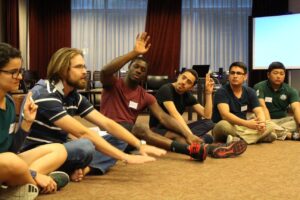
Over three transformative days, students ages 16–24 dive into:
- Socratic discussions of great texts — exploring works from Aristotle, Epictetus, Tocqueville, and more, guided by expert facilitators trained in collaborative inquiry.
- Hands-on workshops in critical thinking, communication, and creative problem-solving — the exact skills employers say are disappearing in the AI era.
- Real-world application sessions — connecting ideas from philosophy, economics, and psychology to the challenges of the modern labor market.
- Small-group collaboration that builds confidence, intellectual courage, and the ability to articulate your own ideas clearly and respectfully.
- A supportive, high-energy community of curious young people from across the country, all committed to thinking for themselves and understanding the world more deeply.
It’s an immersive, energizing weekend designed to strengthen the capacities that set you apart in the Allocation Economy: judgment, reasoning, communication, and the ability to ask the right questions.
Register today for the Great Connections Weekend Seminar — and start becoming the kind of leader AI can’t replace.